
How to Build an In-House Inventory Merchandising System
Dealerships that want consistent presentation, faster time to market, and greater operational control are increasingly building an in-house inventory merchandising system.
Since 1996, DealerVision.com has worked alongside dealerships to refine simple, repeatable merchandising workflows that real teams can execute every day. We’ve seen what works, what breaks down over time, and what actually holds up in a fast-paced dealership environment.
An in-house inventory merchandising system is more than just taking photos or recording videos. It is a structured process that governs how vehicles are captured, organized, published, and maintained across your website and third-party marketplaces.
When implemented correctly, merchandising becomes predictable and scalable. Instead of relying on one highly skilled individual or an outside vendor, the dealership builds a workflow that supports consistency, accountability, and inventory turn.
This guide outlines what an effective in-house inventory merchandising system includes and how to build one that your team can follow with confidence.
What an In-House Inventory Merchandising System Includes
Inventory merchandising is often associated with vehicle photos, but a complete in-house system includes several coordinated components working together. This applies not only to automotive dealerships, but also to RV, truck, and specialty inventory sellers who rely on consistent online presentation.
At a minimum, an effective merchandising system includes:
Vehicle Photography
Clear, consistent exterior and interior images captured using a defined shot sequence.
Walkaround Video
VIN-specific videos that help shoppers experience the vehicle before visiting the lot.
Background and Presentation Control
Standardized backgrounds, overlays, or visual treatments that maintain brand consistency across listings.
Equipment Labels and Buyers Guides
Accurate, compliant documentation generated as part of the intake process.
Inventory Organization and Publishing
Structured uploads tied to VIN or stock number, ensuring vehicles go live quickly and consistently across platforms.
Quality Control and Accountability
A review process that confirms every vehicle is fully merchandised and meets dealership standards before publication.
When these components operate independently, inconsistencies appear. When they operate as a coordinated system, merchandising becomes reliable and scalable.
Why Structured Systems Outperform Individual Talent
Many dealerships assume that strong merchandising depends on hiring a talented photographer. While skill certainly helps, long-term consistency depends far more on structure than individual ability.
Dealerships experience staff turnover. Roles shift. Volume fluctuates. If merchandising depends on one highly skilled person, quality can decline quickly when that person leaves or becomes unavailable.
A structured merchandising system removes that vulnerability.
When the process is documented, repeatable, and supported by workflow tools, multiple team members can execute it successfully. The dealership gains:
-
Consistent presentation across inventory
-
Predictable time-to-market
-
Reduced operational disruption
-
Clear accountability
Over time, the system becomes the asset — not the individual.

Core Components of a Structured Inventory Merchandising System
A successful in-house inventory merchandising system does not rely on guesswork. It is built on a few foundational components that keep execution simple and repeatable.
1. A Defined Capture Workflow
Every vehicle follows the same shot sequence and capture order. Exterior angles, interior views, key features, and required documentation are captured consistently. This reduces missed photos and eliminates inconsistency between units.
2. Flexible Device Usage
The system should allow capture using smartphones, tablets, or cameras already available in the dealership. Equipment should support the workflow, not complicate it.
3. VIN or Stock-Based Organization
Photos and videos must be tied directly to the correct vehicle through VIN scanning or stock number entry. Clear organization prevents mislabeling and speeds publishing.
4. Background and Brand Control
Whether using on-lot capture, a physical photo booth, or digital background management, presentation standards should remain consistent across all inventory.
5. Immediate Publishing Workflow
The faster inventory goes live, the better. A structured system ensures media is uploaded, reviewed, and published without unnecessary delay.
6. Simple Quality Control
A final review step confirms each vehicle meets merchandising standards before appearing online. This prevents incomplete listings and protects brand consistency.
When these components are aligned, merchandising shifts from being reactive to being operationally reliable.
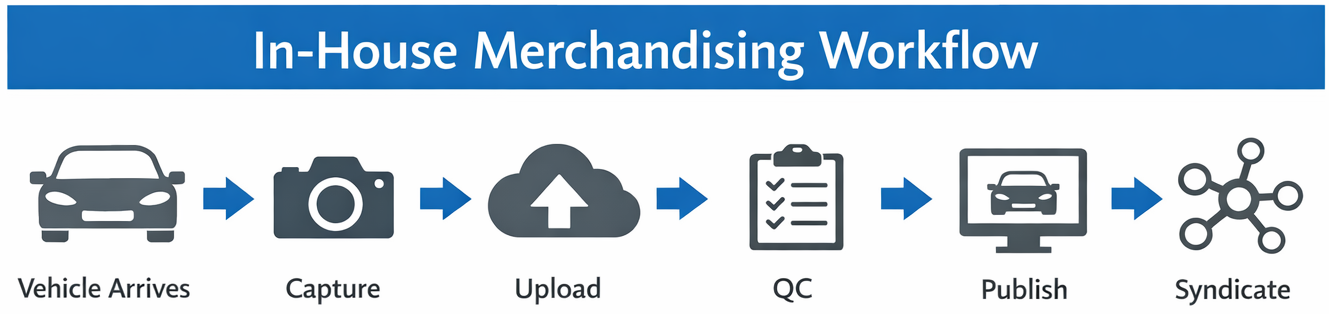
What a Day Looks Like in a Structured Inventory Merchandising System
When merchandising is built into daily operations, it becomes a routine — not a disruption.
Here’s what a typical day might look like inside a dealership with a structured in-house system:
Vehicle Arrival and Recon Completion
Once a vehicle completes recon and is front-line ready, it moves directly into the merchandising workflow.
Capture Process (10–15 Minutes per Vehicle)
A designated team member follows the predefined shot sequence using a smartphone, tablet, or camera. Exterior angles, interior views, feature highlights, and required documentation are captured in a consistent order.
Because the workflow is standardized, capture does not require professional photography training; it only requires adherence to the process.
Upload and Assignment
Media is uploaded immediately and assigned by VIN or stock number. Files are automatically organized under the correct vehicle record.
Background and Presentation Adjustments
If background replacement or overlays are part of the dealership’s standards, they are applied during processing.
Quality Review
A quick review ensures that all required images are present and meet dealership standards.
Publishing and Syndication
The vehicle goes live on the dealership website and feeds out to third-party marketplaces.
From arrival to publication, the process is predictable and repeatable. Instead of waiting on an external vendor schedule, the dealership controls its own time-to-market.
Common Failure Points in In-House Inventory Merchandising
Building an in-house merchandising system is straightforward in theory, but execution can break down without structure and accountability.
These are the most common failure points dealerships encounter:
1. No Documented Shot Sequence
When team members are not following a defined capture order, vehicles end up with inconsistent angles, missing features, or incomplete galleries. Over time, listing quality declines.
2. Delayed Publishing
Photos that sit unprocessed for days defeat the purpose of bringing merchandising in house. Speed is one of the primary advantages of internal control.
3. Over-Reliance on One Individual
If the entire system depends on one highly capable employee, the process becomes fragile. Staff turnover or role changes can disrupt consistency.
4. Lack of Quality Control
Without a final review step, incomplete listings can go live. This reduces buyer confidence and creates unnecessary corrections later.
5. No Accountability Tracking
Dealerships that do not monitor capture completion or time-to-market often see performance drift over time.
Most in-house merchandising challenges do not come from equipment limitations. They come from inconsistent execution.
When a structured workflow is supported by clear standards and oversight, these issues are preventable.
Scaling an In-House Merchandising System Across Multiple Rooftops
For dealer groups operating multiple locations, merchandising consistency becomes even more critical.
Without a structured system, each rooftop may develop its own habits, standards, and presentation style. Over time, this creates brand inconsistency across the group’s online presence.
A scalable merchandising system addresses this challenge by standardizing:
-
Shot sequences across all locations
-
Background and presentation standards
-
Video structure and branding
-
Equipment labels and documentation formats
-
Quality control expectations
-
Publishing timelines
When every rooftop follows the same operational framework, inventory presentation becomes unified, regardless of store size or staff experience.
Scalability also requires visibility.
Group leadership should be able to monitor:
-
Capture completion rates
-
Time-to-market performance
-
Listing consistency
-
Workflow compliance
Without reporting and oversight, standards tend to drift over time.
A properly structured in-house merchandising system allows dealer groups to maintain centralized control while enabling each location to execute efficiently.
How DealerVision.com Supports Structured In-House Merchandising
Since 1996, DealerVision.com has worked with dealerships and dealer groups to refine simple, scalable inventory merchandising systems that hold up in real-world environments.
The platform was built around one core principle: merchandising should be process-driven, not talent-dependent.
DealerVision.com supports in-house inventory merchandising by helping dealerships:
-
Standardize capture workflows across rooftops
-
Organize media by VIN or stock number
-
Maintain consistent background and presentation standards
-
Generate compliant equipment labels and buyers guides
-
Publish quickly to websites and third-party marketplaces
-
Monitor workflow performance and time-to-market
Rather than replacing internal teams, the system supports them, providing structure, visibility, and operational consistency.
For dealerships transitioning from outsourced photography or scaling internal operations, a structured platform is the foundation that keeps merchandising predictable over time.
When merchandising is treated as infrastructure instead of a side task, results improve across speed, consistency, and brand presentation.
Building a System That Lasts
An effective in-house inventory merchandising system is not about buying equipment or hiring the perfect photographer. It is about creating a repeatable process that your team can follow every day.
When the right tools and clear standards support that system, merchandising becomes an operational advantage, not a bottleneck.
Dealerships that invest in structure gain control, scalability, and long-term stability in how their inventory is presented online.
Ready to Build a Structured In-House Merchandising System?
Talk with our team about how DealerVision.com supports scalable photography and video workflows across single rooftops or multi-location dealer groups.
Schedule a Demo today
